Exploring Algorithms & Data Structures in Music Streaming
YouTube Music is a music streaming service developed by Google that offers access to a vast library of songs, albums, playlists, remixes, live performances, and user-generated content such as covers, all sourced from YouTube's extensive platform. As a software developer with a passion for music and technology, I've chosen YouTube Music for its influential role in music streaming and its robust platform for algorithmic development. It not only enriches the listening experience but also provides an ideal environment to apply cutting-edge algorithms and data structures.
Key objectives include exploring and determining the efficient solutions for music recommendation, playlist generation, data analysis, and user management. Each section showcases the application of theoretical concepts in practical settings, emphasizing innovation and optimization within YouTube Music's dynamic platform.
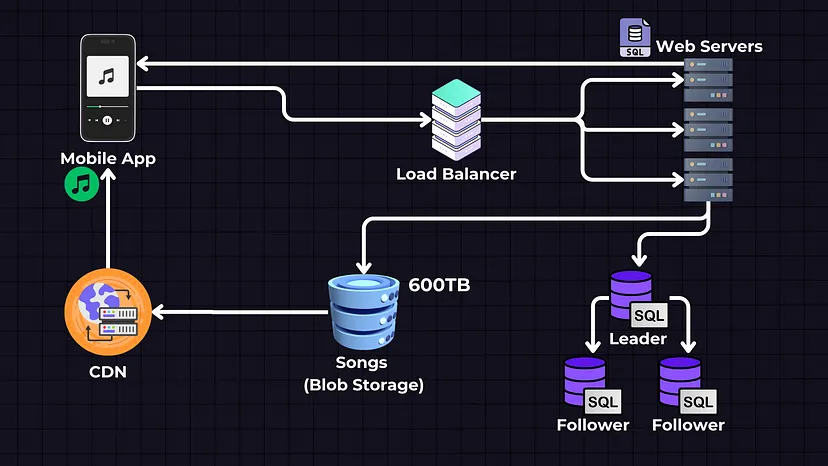
YouTube Music is built on top of Google's cloud-scale infrastructure and shares many core components with YouTube:
| Data Structure | Use Case |
|---|---|
| Hash Tables | Quick access to cached metadata and user session info |
| Graphs | Model user-item interaction, content similarity, co-listening patterns |
| Tries / Prefix Trees | Autocomplete and search suggestions |
| Heaps | Priority queues for top-N recommendation systems |
| Bloom Filters | Efficiently test content existence in large-scale systems |
| Inverted Indexes | Fast search and retrieval across millions of songs |
YouTube Music uses a smart method called Personalized PageRank to recommend songs and videos you might like. It works by building a network (or graph) where each song or video is a point (called a node), and connections between them (like if two songs are often played one after another) are the lines (called edges). The system then simulates how a user might explore music, randomly jumping from song to song, but often restarting from something the user recently listened to.
Data Structure: Co-visitation Graph (songs as nodes, co-listens as edges)
Data Structure Type: Graph (songs/videos as nodes, user co-visitation as edges)
Personalized PageRank recommends songs by analyzing a graph where each node represents a music item (song or video), and edges connect items that are frequently played together or appear in similar user sessions. The algorithm performs a random walk starting from a user's recently played items, with a probability of "restarting" back to the original song to ensure relevance. This results in a ranking of nearby content based on how often it can be reached through the walk.
Personalized PageRank avoids full graph traversal and focuses on local neighborhoods, making it scalable for millions of songs and users. It's often combined with approximate methods or precomputed partial results for real-time use.
YouTube Music playlist generation feature allows users to create and manage personalized playlists seamlessly. This functionality uses a linked list data structure to handle the order and metadata of songs efficiently, making it easy to add, remove, or rearrange tracks. The linked list structure ensures that playlist operations, such as inserting or deleting songs, are performed with optimal time complexity. To enhance the playlist creation experience, YouTube Music employs a greedy algorithm for playlist optimization, which selects songs based on user preferences and listening habits, ensuring that each playlist offers a coherent and enjoyable listening experience.
| Operation | Singly Linked List | Doubly Linked List | Explanation |
|---|---|---|---|
| Insert at head | O(1) | O(1) | Just change/add pointers at the beginning |
| Insert at tail | O(n) | O(1) (with tail ptr) | Singly needs traversal; doubly can store a tail pointer |
| Insert in middle | O(n) | O(n) | Requires traversal to the position first |
| Delete at head | O(1) | O(1) | Adjust head pointer (and possibly prev in doubly) |
| Delete at tail | O(n) | O(1) (with tail ptr) | Singly must traverse; doubly can go backwards |
| Delete in middle | O(n) | O(n) | Must find node first, then adjust links |
| Search | O(n) | O(n) | Linear traversal needed (no indexing) |
| Traversal (full) | O(n) | O(n) | Visit all nodes once |
| Reverse list | O(n) | O(n) | Re-link all nodes |
Semantic/Vector Search transforms the way we find music by understanding the meaning or intent behind your search query, rather than just matching keywords. It works by converting both your search query (like "upbeat song for working out" or "lyrics that go like 'shine bright like a diamond'") and the information about songs in the database (titles, lyrics, artist descriptions, genre, user tags) into numerical representations called "vector embeddings".
Imagine a vast multi-dimensional space where each song and each query is a point (vector). Songs with similar meanings, moods, lyrical themes, or styles will be located close to each other in this space. When you search, the system converts your query into a vector and then efficiently finds the song vectors that are nearest to your query vector.
YouTube Music social features allow users to connect with friends, share music, follow artists, and collaborate on playlists. These features use a graph data structure to model relationships and interactions between users and artists. By implementing algorithms such as Breadth-First Search (BFS) and Depth-First Search (DFS), YouTube Music efficiently manages and traverses these connections, enabling users to discover new music through their social network. The social graph helps in generating personalized recommendations based on a user's social activity and preferences, fostering a community-oriented experience on the platform.
Data Structure: Graph
Algorithm: BFS/DFS for Connectivity
Complexity: O(V + E), where V is the number of vertices (users) and E is the number of edges (connections)